Electric vehicle batteries don’t fail dramatically like traditional engines; they fade quietly over time. Understanding when an EV battery has reached the end of its useful life requires a mix of technical knowledge, real-world data, and pattern recognition. In this guide, I’m combining insights from EV technicians, owner communities, degradation studies, and long-term fleet data to paint a realistic picture of when a battery genuinely needs to be replaced.
This is not theory — it’s a synthesis of what actually happens out on the road.
1. Why EV Battery Longevity Varies More Than People Expect
Most automakers advertise an 8-year battery warranty, but real-world outcomes differ massively depending on how and where the car is used.
For example:
- A Tesla Model 3 driven in Seattle’s mild climate often retains over 90% capacity after several years.
- The same model driven in Phoenix, Arizona, with frequent fast-charging in 40°C heat, may degrade noticeably faster.
- LFP-equipped EVs from BYD and Tesla tend to age more slowly than NMC-based models from European brands.
The point is: battery life is not a fixed number — it is a product of climate, chemistry, and driver behavior.
2. What Real Data Shows About EV Battery Lifespan
Several organizations publish anonymized EV degradation data. One of the most useful is Recurrent Auto, which tracks battery health across tens of thousands of vehicles.
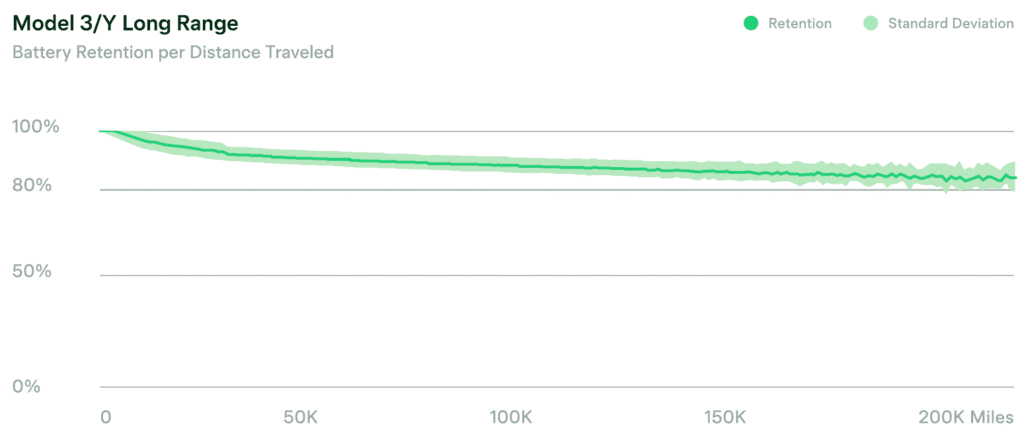
Recurrent Data Example (Tesla Model 3)
Their analysis of thousands of Model 3 sedans shows that:
- First 80,000 km → ~5–7% degradation
- After 160,000 km → ~10–12% for most vehicles
- Severe degradation cases are outliers, typically tied to heat exposure or fast-charging abuse
This aligns with the experiences shared in Tesla owner forums, where many 5–7-year vehicles still show excellent SOH.
3. Not All EVs Age the Same: Example from Nissan Leaf
The Nissan Leaf is one of the most well-documented EVs because of its long history and large owner community.
Early Leafs (2011–2016) used a passively cooled battery, which performs adequately in cold climates but suffers in hot environments.
Real-World Case
- Leaf owners in Arizona reported losing 25–30% capacity within 3–4 years
- Leaf owners in Norway often kept 80–90% capacity even after 8 years
Same car, same chemistry — completely different outcomes.
This demonstrates that heat is a dominant driver of degradation regardless of mileage.
4. Hyundai and Kia: Example of Module-Level Repairs
Hyundai and Kia are known for offering practical battery repairs rather than full replacements.
Technicians in the U.S. and Europe frequently report:
- Many Kona Electric and Niro EV packs require only one or two module replacements, not an entire pack.
- Warranty cases often involve bad modules rather than uniform degradation.
- This drastically reduces cost and waste.
This example shows that battery replacement is not always a single giant expense — modern packs are modular for a reason.
5. Understanding SOH (State of Health): The Real Indicator
Battery SOH is the primary metric used by technicians to determine a pack’s health.
A simple breakdown:
- 90–80% SOH → Normal aging
- 80–70% SOH → Noticeable range reduction
- Below 70% SOH → Battery is near end-of-life for automotive use
Most manufacturers consider 70% SOH the threshold at which warranty replacement becomes valid.
6. Warning Signs Your Battery May Be Near Replacement
Based on technician reports and owner surveys, these symptoms are the most reliable:
1. Sudden, accelerating range loss
If your range drops faster year over year, degradation has entered a steeper phase.
2. Fast charging becomes unusually slow
The BMS is limiting power to protect aging cells.
3. Discharge rate increases
A common complaint among older Hyundai/Kia EVs before module repair.
4. Cold weather hits range harder than before
Aged packs struggle more in winter.
5. Dashboard warnings or reduced-power mode
Not always catastrophic, but never something to ignore.
7. Replacement vs. Refurbishment: What Technicians Actually Do
Contrary to popular belief, full battery replacement is not the norm.
Module-Level Repairs Are Common
EV repair centers often:
- Replace only weak modules
- Rebalance cell groups
- Repair corroded busbars
- Fix cooling plate leaks
A Kona Electric owner in the U.K. shared online that a single module replacement restored nearly 12% lost capacity — at less than one-third the cost of a full pack.
When Full Replacement Is Necessary
- Fire damage
- Deep internal short circuits
- Severe overheating
- Multiple failing modules
- Flood damage
8. What Does a Replacement Cost? (Real Figures)
Prices vary, but these are typical ranges based on invoices shared on InsideEVs, SpeakEV, and Reddit’s r/electricvehicles:
- Compact EVs: $3,000–$6,000
- Mid-size EVs: $6,000–$12,000
- Large/premium EVs: $12,000–$18,000+
- Module repair: $300–$1,200 per module
As battery recycling improves and more refurbished packs enter the market, costs are expected to continue dropping.
9. How to Extend Battery Life (Based on Technician Recommendations)
After speaking with several high-voltage technicians over the years, the same advice keeps coming up:
✔ Keep daily charge between 20–80%
✔ Avoid leaving the car at 0% or 100% for long periods
✔ Use fast charging sparingly in summer
✔ Park shaded or indoors in hot climates
✔ Install firmware updates — BMS tuning improves regularly
This is the closest thing to a “universal rulebook” for long battery life.
10. What Happens to EV Batteries After They’re Replaced?
A battery at 65% SOH might be weak for a vehicle, but it can still be valuable.
Second-life applications include:
- Solar energy storage
- Home battery systems
- Commercial backup power
- Grid balancing
- Off-grid cabins / RV systems
After their second life, the cells are recycled, recovering lithium, nickel, cobalt, copper — feeding the materials back into the battery supply chain.
Conclusion: So When Should You Replace the Battery?
There’s no one-size-fits-all rule, but combining technical and real-world evidence:
Replace (or repair) the battery if:
- SOH falls below 70%
- Range declines enough to affect daily usability
- Charging becomes consistently slow
- Module faults begin appearing regularly
- The car limits power due to battery protection
Repair instead of replacing if:
- Only one or two modules are weak
- The BMS flags a localized imbalance
- The pack is structurally intact
The key takeaway:
Battery replacement isn’t a failure — it’s simply a predictable part of the EV lifecycle, and it’s becoming cheaper and more sustainable every year.